|
|
|
|
|
|
|
|
|
|
|
The Afterlife Details on Biblical terms including: Hell, Heaven, Sheol, The Abyss, Hades, Gehenna, The Lake of Fire, New Heavens & New Earth, Abraham's Bosom, Paradise, Tartarus, the Pit, The Grave, Under the Altar. |
||||||||||||||||||||||||||||
|
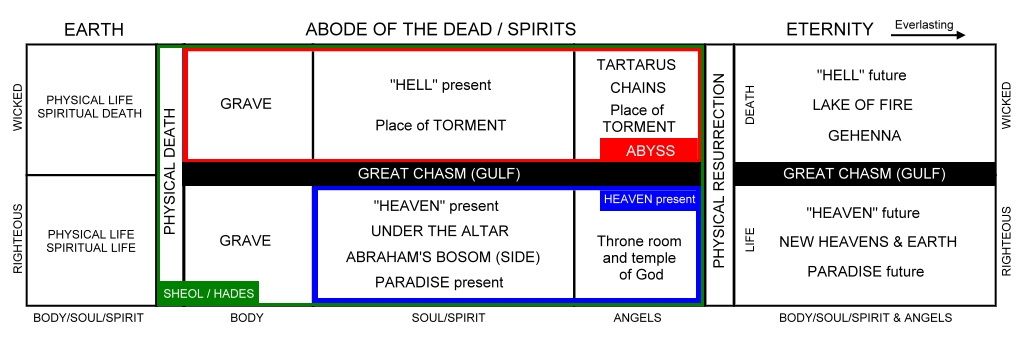
Editor's Note: While all parts of this article help to portray a complete picture of the afterlife, take note that the included footnotes provide integral information highly relevant to fully understanding this subject and each specific term under examination. In this reworking of the original article, immediately following a few introductory sections, the main work is a glossary of terms featuring expanded details, interrelated words, and related questions. Old Testament First, New Testament Final While many want to jump immediately to a particular term in the New Testament, be aware that the New Testament was built on the Old and presupposes an understanding of the former. God, in His infinite wisdom, choose to give His written word as a progressive revelation. He did not give it all at once, nor did He provide complete details on every subject especially in the Old Testament. Some concepts only appear as a shadow of the fullness that would be revealed following the advent of Jesus Christ. Complete doctrine for the church must be based on the totality of Scripture, allowing the New Testament to clarify and expound upon concepts found in the Old Testament. Some believers and denominations have elevated ideas seemingly rooted in the Old Testament. Doing so in opposition or willful ignorance to further revelation (clarification) in the New Testament creates a false picture of what God's word really teaches. General versus Specific Terms Some words are intended to have a general and broad usage. This is true for the English language and also for the Biblical languages. For example, the Greek word translated "angel" can equally and validly be translated into English as "Messenger". "Messenger" is the broad meaning of the word, yet we know that sometimes the "Messenger" is a heavenly messenger versus an earthly messenger. So how can a translator use the word "angel" for some occurrences and not for others? Simply put, the context establishes which word better represents the though being expressed in any particular passage. Many of the words associated with the afterlife are likewise context sensitive and can mean something quite different based on who they are in reference too. English language translators have often tried to use popular terms (e.g. hell) to translate particular occurrences of some of these general terms. While well meaning, it sometimes has obscured exactly what the overall text is describing. All too often people interpret Scriptures by superimposing common popular ideas associated with particular English words. True comprehension of the passage comes from understanding the entirety of what was meant by specific word choices in the original language. If this cannot be conveyed by a single word, it would be far better to use many words or a footnote to help describe it (which some translations now do to one degree or another). Before moving on, also note that some words can have a specific and general meaning or usage. Once again, the context shows whether or not it is being used a specific technical term or in a broader more general way. A picture is worth... This chart attempts to summarize the differences and similarities of each term considered within this article. NOTE 5 In a visual manner specific technical terms are shown to exist within broader general terms especially through the use of borders and colors. It will aid you to keep this chart nearby while reading the following definitions.
|
||||||||||||||||||||||||||||
|
Salvation throughout human history To understand the end, it first requires knowledge of the beginning. The Bible clearly notes that following the sin of Adam and Eve in the garden, every subsequent person was born into sin and certainly not righteous.
If there is a difference in final outcomes for those who are wicked and those called righteous, the big question is "how did anyone go from being wicked to righteousness?" Another word for being declared and becoming righteous is "salvation". Every person who has ever found salvation has done so through faith in Jesus Christ.
Prior to the birth of Jesus this entailed trusting in God that He would fulfill His promise and make provision for salvation through the coming Messiah. While the amount of detail expanded throughout Old Testament times, the simple promise of a Messiah was part of God's words, and a source of hope, from the very beginning. Even as God handed down His punishment and judgment over the original rebellion in the Garden of Eden, hope was given:
It was in anticipation of this salvation that Job could confidently assert:
With the coming of Christ (the Messiah), we have the realized fulfillment of all those Old Testament hopes. Not only do we know far more about Him, we now look back and place our faith in Jesus Christ and His accomplished work. How could any individual be saved before Jesus actually (in time and space) died and rose again? Because it was predetermined and decreed by God (who cannot change his mind or lie, 1 Samuel 15:29) and, as such, was an accomplished fact from before the creation of the world.
The kingdom was prepared for believers from the creation of the world. Consider the following words which were spoken before Jesus died and rose again!:
God chose believers before the creation of the world (appointing all who would believe. See Acts 13:48).
God set apart Jesus to die as the perfect Lamb of God before the creation of the world, before anyone ever sinned!
Not only was Jesus set apart before the creation of the world, He was counted as slain from the creation of the world.
Believers who died in Christ before Jesus was physically crucified in time and space did not have to wait for the future act. It was planned and promised and credited as accomplished from the very beginning. The outcome, or accomplished end result, of Jesus' redemptive acts are recorded as absolutely achieved from the very beginning. Take note that the names of all believers, throughout all the ages, were written in the Lamb's Book of Life from the creation of the world (see Revelation 17:8).
|
||||||||||||||||||||||||||||
|
Sheol is a general, non-specific, term used throughout the Old Testament in reference to the grave or the next life. Only context allows any specifics to be derived, or implied, in any particular usage of this word. Rather than leave a non-specific term, some English translations have rendered the word as grave, pit, and hell. Confusion arises as the latter, of course, is considered to be a very specific and defined location. Unlike modern use of the word "hell", Sheol is not used exclusively and specifically to describe a place of torment or punishment for the wicked. The following four statements illustrate how the word Sheol employs extremely wide usage within the Old Testament.
Little can be implied about the actual makeup of Sheol from the Old Testament. The mere presence of the righteous and the wicked does not provide sufficient evidence as to any specific components or locations within Sheol. It is not until the New Testament that God clarifies and expands on many themes and allusions in the Old Testament. Some have taken passages regarding Sheol and understood them too literal or made them out to be technically specific. For example; those who claim soul sleep, holding that the soul sleeps in the ground with the body until the resurrection, often cite passages such as the following...
Yet, the New Testament, as we will see later, speaks of conscious activity after death. This New Testament clarification shows that the Old Testament passages cannot be taken literally. Remembering that Sheol can be used as a synonym for death or the afterlife, these verses are merely stating that normal activity of the living ceases upon death. As such these statements make no specific assessment of what the dead will be doing in the afterlife let alone where. In a general sense, and with certainty, we can agree that the voices of the righteous and the wicked are silenced in the land of the living upon their deaths - neither have the ability to speak to those still living. Since Sheol is a word that can mean grave, descriptions and imagery associated with the term often pertain to a literal grave in the ground, namely concepts of darkness, decay and dust. For example:
The usage of such terminology neither implies that there is nothing beyond the physical grave nor does it make any characterization as to the specific destination of the soul in the afterlife. In the same way, referring to Sheol as something you dig down to in no way implies that the afterlife is somehow literally below us; again the symbolism is that of a literal grave.
If we only had Old Testament passages utilizing the word Sheol, our understanding of the afterlife would be extremely limited. Indeed, some scholars have claimed the New Testament concepts of the afterlife are a late invention of their period. Rather it is God choosing to reveal more details only as they are necessary, by His timing and authority. Hades [Greek, New Testament; Greek, Old Testament] Hades is a direct synonym, or translation substitute, of the Hebrew word Sheol. When the Hebrew Bible was translated into Greek in the centuries prior to Christ, the translators uniformly used the term Hades for Sheol. In fact, showing Divine acceptance of this equivalency, New Testament passages referencing Old Testament scriptures about Sheol also utilize the Greek term Hades. This means that everything said about Sheol can also be said about Hades, yet Hades can (and does) have more details given than did Sheol. For the record; the Greek word Hades was the proper name of the god of the underworld in Greek mythology (i.e. Homer) and the underworld could be called "the house of Hades." Even as words in our language are derived from pagan sources (including month and day names), usage in Scriptures in no way implies Scriptural acceptance of the mythological Hades. The word Hades, through popular usage, merely became synonymous with the afterlife or the grave. NOTE 18 Again, take note that using an equivalent term to Sheol does not preclude God from revealing additional details about Hades in the New Testament. Progressive revelation enables the New Testament to better clarify the Old. In the New Testament, Hades is portrayed as the between state which follows death and yet is prior to final judgment and the state thereafter. This view echoes that of the Old Testament and is even mentioned by the first century historian Josephus as being a belief of the Pharisees in the time of Jesus.
Josephus may have only been summarizing a longer position. In this quote, if Josephus is compete; the Pharisees may not have believed in anything other than a continuous state of torment and prison, for the wicked in Hades, for all eternity. But, in Scriptures, God makes it unquestionably clear that the Lake of Fire is the final destination of all wicked; the New Testament especially expanding on this detail. Some of the ways Hades is referred to:
Undeniably a majority of references to Hades, in New Testament passages, emphasize the state of the lost or figuratively have association with wicked supernatural powers. This has led some to believe that Hades can only be used in reference to non-believers in the New Testament. This restriction is dubious at best and quite improbable as word equivalency between Sheol and Hades showed common use and understanding in New Testament times to be otherwise. Acts 2:27, 31 certainly refer to Hades in the exact same way as the Old Testament Sheol, as the grave or afterlife, being a general destination for both the wicked and the righteous. As the New Testament provides more specifics regarding those who are saved, it is logical that more precise terms are widely used for their state. In the account of Lazarus, Hades is likewise used in a broad sense as a destination for the righteous and the wicked. Both Lazarus and the rich man had died and gone to Hades (Luke 16:22-23), yet further clarification showed the more specific state of both of them within Hades... Lazarus was with Abraham in the presence of God (i.e. the present heaven) and the rich man was separated from God (and all that is good) in a place of torment. While both are in Hades, they are far removed from each other as to their specific destination within it (i.e. Luke 16:23, 26). Some claim that Revelation chapter 20 shows that Hades was later changed into a place that was only for the wicked (perhaps after Jesus' resurrection).
Undoubtedly this passage does show death and all of Hades being cast into the Lake of Fire, but a seminal event had taken place immediately prior. The resurrection from the dead of all those written in the Lamb's book of life (i.e. Revelation 20:4-6) meant that Hades no longer had any righteous occupants at the time of its destruction in the Lake of Fire. NOTE 12 This later removal of all righteous cannot be used to diminish the fact that Hades had been a destination for all throughout prior ages. A related question regarding Hades (as a place for all departed dead, righteous and unrighteous, and any wicked powers): Who absolutely rules over it? Contrary to cartoons and popular imagery, it is not the Devil.
Jesus is said to hold the keys, absolutely, of Hades and death. Nowhere does it say that Jesus ever didn't have them or lost them and had to reacquire them. Jesus holds and controls the keys. As the One who controls them, Jesus has the right to give any key to whomever he wills for a time. According to Scriptures, the key of the Abyss is given, only for a time, to the Destroyer (i.e. the Devil, John 10:10) for the purpose of judgment (see Revelation 9:1-11). God can use even the Devil to accomplish His purposes, even as He has used demons (e.g. 1 Kings 22:21-23) and cruel and pagan nations for the same (e.g. Isaiah 45:13; 7:18-20).
Simply
put: Everybody goes to Hades. |
||||||||||||||||||||||||||||
|
The Abyss [Greek, New Testament] The Abyss is, at best, a partial synonym of Hades (Greek) and Sheol (Hebrew), but typically with a specific focus. Every reference to the Abyss in the scriptures, except one, focuses on the part of Sheol or Hades where supernatural beings (i.e. fallen angels) are confined. If only these passages were in view, it would be a direct synonym of Tartarus. While Tartarus aspect of Hades is normally and usually in view; the Abyss can also be used in a general sense as a word meaning "the grave" or "the abode of the dead" (sometimes translated as the "bottomless pit" or "the deep"). This use of the Abyss is similar to the Hebrew word Sheol, or the Greek word Hades, but it focuses on the aspect of Sheol/Hades where the fallen or wicked are (versus where the righteous are in the presence of God). The one example of this in Scriptures comes from the apostle Paul...
The Complete Jewish Bible actually renders the word "Abyss" as "Sheol" in their translation, but this is true only on a limited basis. NOTE 15 The few additional usages of the Abyss in the New Testament, a total of nine occurrences, show the general state of Sheol to include a holding place for demonic entities. This may be the same general place as that which exists for ungodly humans, but there is never shown to be a mingling of departed human and demonic entities. This lack of interaction has led to speculation that the Abyss must be a completely separate place than Sheol/Hades, which might be logical except that the previously quoted passage in Romans 10 expressly represents the Abyss as an overall synonym for the abode of the unrighteous dead NOTE 16. It is safe to say that there is a general portion of Hades/Sheol, called the Abyss, which is allocated for all unrighteous. Yet, if the word is used in a technical sense (the most common way it is used in Scriptures) is specifically references the portion of Hades/Sheol that is allocated for some fallen spirits awaiting final judgment. Some examples of the later...
Certainly the implication of the account of the demons, in Luke 8, show that they rightly fear the Abyss as a place of punishment, even as the Hades/Sheol is a place of punishment for the wicked, until it all ends up in the Lake of Fire for a final destination. That Satan could be freed from the Abyss (i.e. Revelation 20:3) does not in any way diminish the permanency of Hades/Sheol for non-believers. God has the ability to release anyone from Hades as He desires, as Jesus has always held the keys of Hades and death, and He will ultimately release all unbelievers from Hades, for final judgment, prior to their being cast into the Lake of Fire. Tartarus [Greek, New Testament] Tartarus is a synonym of the primary, or technical, usage of the term Abyss. It invokes imagery of a dungeon for fallen angelic beings.
Jude also uses the same imagery, without providing the place name, but unquestionably is referencing the same place.
Similar to the origin of the name Hades; the term Tartarus was likewise derived from Greek mythology. Within these classic myths, Tartarus was said to be the lowest abyss of Hades, a place where demigods were punished. Peter's use of the word does not ascribe any belief in the Greek myths; he merely used a common word to illustrate a revealed place within Hades/Sheol. Here God has bound over fallen spirit-beings for punishment while awaiting their final judgment. Gehenna [Greek, New Testament] Gehenna is a term that is always used in reference to the state of the wicked after death. As such, while symbolic in name, it is an idiom that could designate the condition of the lost in Hades/Sheol, yet it more properly pertains only to their final state. The name itself is derived from a physical location referenced in the Old Testament. This valley, the Valley of Hinnom, located south of Jerusalem, was infamous for its pagan rituals and even child sacrifice (e.g. 2 Kings 23:10, Jeremiah 19:6). Years of ritual fires and burning humans were the image invoked upon hearing the name. To use a word derived from such a place was to give association with godlessness and perpetual fires. The final destination for unbelievers and all wickedness is biblically shown to be a place of unquenched fire, also called the Lake of Fire. Jesus frequently employed the term Gehenna and its' associated imagery...
Gehenna is distinguished from the general term Hades/Sheol, or even the Abyss, as it is specifically noted for its finality. It is shown to be an ultimate destination rather than any interim location encompassed by the term Hades. While Hades/Sheol is said to receive the soul (i.e. Acts 2:27, 31), Gehenna takes both the body and the soul:
Jesus even reserved Gehenna for one of his most severe warnings. He called the Pharisees, children of Gehenna...
While the Old Testament mostly refers to the state of the dead using the general term Sheol, with little distinction between the wicked and righteous, the concept of an unquenchable fire as a final destination for those in rebellion against God is also found in the Old Testament. Against the backdrop of the future New Heavens and Earth, a Gehenna-like place is clearly spoken of...
This location of unquenchable fire, referenced in Isaiah, is shown to be a reference to Gehenna through a direct citation incorporated into Mark 9:43-48:
Lake of Fire [Greek, New Testament] The "Lake of Fire" is a descriptive phrase which is a direct synonym of Gehenna. This location is only referenced by this term in the book of Revelation, where it is also specifically called "the Second Death", another descriptive term.
Jude, without using a specific name for the place, certainly references it:
Jude's usage was not much different than that of Jesus, who sometimes referred to Gehenna or the Lake of Fire in an indirect manner also.
All
references in view; the Lake of Fire is shown to be the second death,
which is eternal punishment in a place of endless fire. While
many attempt to downplay the "eternalness" of this place,
the passages already cited go out of their way to emphasis this
ceaselessness of this state. |
||||||||||||||||||||||||||||
|
Varied usage of this word "Hell" by translators had contributed to the popular meaning of this word in modern English. Scripture passages pertaining to the general words "Sheol" and "Hades", plus the more specific "Gehenna" and Lake of Fire, have all been translated using the word Hell. For most, Hell has come to simply mean the destination of the wicked in the afterlife (whatever and wherever that may be). Details drawn, often randomly, from various Bible passages then provide a description of this place, commonly merging aspects of Hades/Sheol and Gehenna. Broad usage of the word Hell is not necessarily incorrect, wherein it properly conveys a place of torment for all unbelievers. The danger though is that it may obscure the concept encompassed in Scriptures of the general usage of Hades/Sheol for both believers and unbelievers and even the non-permanency of the interim state of Hades/Sheol versus the final state of Gehenna or the Lake of Fire. NOTE 17 If used broadly; Hell, as such, then means everlasting destruction, in all that encompasses (Hades/Judgment/Gehenna). Scripturally, to experience this "everlasting destruction" is to be banished permanently from the presence of God.
Standard English use of the word heaven shares one of the primary meanings found in the Bible languages - it's a term used to name the supernatural place where God lives and rules. A few of the scriptures which reference heaven in a such a manner include:
Furthermore, while implicit in the previous passages, the Bible is clear that to be in "heaven" is to be in the immediate presence of God.
Even as sheol/hades is represented as being down due to the grave being part of its broad meaning, so too heaven is represented as being up due to the broader alternate meaning of this word. Only context tells which heaven is being referenced; sky, astronomical space, or the supernatural heaven. It's similar to using the word "celestial" in English, it can refer to where the stars and planets are or it may be in reference to the supernatural heaven. Many English speaking people, apart from those familiar with the Bible, only think of heaven in terms of the supernatural heaven. Yet biblically, heaven is a created place encompassed in the opening verse of the Bible:
Within that statement and additional Hebrew usage, the word references the lower heavens, including the sky and the astronomical heavens (both created and filled on the second, fourth, and fifth days), and it is also used of the supernatural dwelling place of God. To differentiate between these three heavens, sometimes they are referred numerically in that order. This is not a new phenomenon; the apostle Paul referred to the supernatural heaven in this manner...
Sin tainted all of creation (e.g. Romans 8:22) and all three heavens are created places. Contrary to a popular perception that heaven is a perfect place, some sin and sinful beings have been in the present heaven (e.g. Job 1:6, 12; 1 Kings 22:19-22) and there has even been war in heaven (e.g. Revelation 12:7). It is for this reason that the final New Heavens and Earth will be exactly that: new! This ultimate eternal destination with be a true home of righteous forever free from sin. The old heavens will all burn:
The present heaven is included in the term Hades/Sheol. When Hades is said to be cast into the Lake of Fire (e.g. Revelation 20:14), it refers to the same thing Peter wrote about above in regards to the heavens. Though it is a place of comfort for the righteous dead, it is temporary and not what we long for. Saints throughout time have desired more, that ultimate and final heaven, the eternal perfect place where there is no more sorrow and no need for comfort. There we are still in the presence of God but fully so, not merely as soul/spirit in the present heaven but complete in our glorified body, soul, and spirit (following the resurrection).
Again, take note that in the present heaven (encompassed in the broad term Hades/Sheol), the soul/spirit is apart from the body. In fact, it appears that the soul, while in the presence of God, can still experience pain or distress (to at least some degree). It is some of these righteous souls that cry out to God, seeking his redress for what had happened to them...
The even earlier account of Lazarus implies the same. If pain had already been wiped away, what need would Lazarus have to be comforted?
Perhaps part of the comfort of the existing heaven is that the soul is separate from the body, our flesh being the source of so much present pain. What is certain is that the resurrection reunites our soul/spirit with a new and glorified body. All who enter the final state of the new heaven and earth will do so with a fully sanctified soul and body (consider 1 Corinthians 15:42-44, 1 John 3:2). Even as Jesus has a resurrected non-perishable physical body, one day all believers will too. It is only after God does away with death at the final judgment, and the final resurrection is past, that we are told that all pain and sorrow is also done away with forever. Never again will anyone need to be comforted as these former things will never come to mind (see Isaiah 65:17 and Revelation 21:1-4, both referenced earlier). This is the unchanging view of the Old and New Testaments. Another related passage from Isaiah...
See Heaven; specifically future heaven or final heaven Paradise [Greek, New Testament] Paradise is an imprecise Greek word that must be established by context. There are three paradises referenced in the Bible, one past, one present and another future. By the time it was being used in the New Testament era, this Greek word had an original general meaning. It was then associated with the first paradise by the translators of the Septuagint who created the Greek Old Testament hundreds of years prior to Jesus. This Greek translation of the Old Testament specifically uses the Greek word for Paradise ("paradeisos") to refer to the Garden of Eden in Genesis 2:8. Why? To the Greek speaking world, even hundreds of year before Jesus, including those not directly aware of the Garden of Eden as defined in Scriptures, the word paradise simply meant "a garden, or park, or enclosure that was full of every beautiful and good thing" (e.g. as used by Xenophon, circa 430 - 354 BC). It was a great word for Eden prior to sin. John, who wrote for a Greek speaking audience, intentionally used this Septuagint wording in regard to a yet future place. All those who have God-given eternal life are said to be one-day participants in the paradise of God and to have a right to eat from the tree of life which is found there.
As a reminder, the original tree of life was first spoken of as being in the original paradise; the Garden of Eden. Again, paradise is a great word for the New Earth that will be the final home for all believers throughout eternity. Due to the general meaning of the word Paradise, any enclosed location that is full of that which is beautiful and good could be described as "paradise". Yet, scripturally, having a high view of the word "good", there are only three referenced paradises NOTE 12.
Having already examined the first and last, consider that the second one was referenced by Jesus, as recorded by Luke, while He hung on the cross...
The apostle Paul later made mention of the same paradise.
Some have argued that Paul's paradise is a fourth location. It is highly unlikely that this is any other place than the positive side of Hades/Sheol. It's direct association with the third heaven, the dwelling place of God, provides further evidence. This heaven is the temporary home for believing souls awaiting the resurrection, a good place of comfort, and one that is said to be in the presence of God (but not in our final and complete state). This makes it the present heaven encompassed in the general term Hades/Sheol, the same place promised to the thief on the cross. Unquestionably, Paul was referring to the present paradise. Throughout history, instead of a single location for the lost and another for the saved, some have tried to add additional possibilities including a temporary destination on the way to heaven. This temporary location is sometimes even referred to as hell, diminishing any belief that hell is necessarily eternal, yet is more properly called purgatory. The underpinnings of this concept do not hold up to the scrutiny of Scriptures. Purgatory is an imagined place of mild torment and preparation for heaven, based solely in the myths and professed authority of the Roman Catholic Church. In their defense of this doctrine, they make a weak appeal to apocryphal additions to scriptures (i.e. Wisdom 3:5-6, 2 Maccabees 12:43-45, Baruch 3:4) plus fanciful interpretations of a few canonical Scriptures (e.g. Matthew 12:32, NOTE 1). From the clear message of the Bible alone, a host of passages show that there is no in between state. For a believer, it is to be absent from the body and to be present with the Lord.
Scriptures further paint a picture of believing souls in the presence of God in the present heaven, conscious and aware, calling upon Him, prior to their resurrection and receipt of a new glorified body (1 Thessalonians 4:16-17, 1 John 3:2).
All these foregoing passages are set aside or reinterpreted based on a preconceived need for purgatory. This preconception allows seeds of confusion to color additional passages including Luke 16:19-31, the account of the rich man and Lazarus. Incredibly, there have been Roman Catholic claims that this passage is illustrative of purgatory. (To be fair, some protestant Christians NOTE 2 use this account as their proof-text for an extra, temporary, state for some believers too. This protestant location or state is then simply referred to as "Abraham's Bosom", which we will examine in a later section). Prior to further examination, a straightforward reading of the passage is necessary:
Roman Catholics, not believing in the absolute sufficiency and completeness of Christ's work on the cross, claim that an interim state is necessary to allow for a person to pay for some of their sins before being allowed into heaven. This is completely against what Scripture says regarding God's absolute salvation and payment in full for our sins. Two passages, out of many, that speak of Jesus' full salvation for all those who believe include:
Unless you believe that Jesus saves completely, your only hope is to invent a halfway solution such as purgatory. For the record, it is not Lazarus that Roman Catholics believe was in Purgatory in this passage; they legitimately hold that he was in heaven with Abraham. It's the rich man they claim to be in purgatory, placing the rich man on his way to heaven sometime in the future, and completely destroying the immediate and clear sense of the account. How do they place the rich man in purgatory? Their entire argument is based upon presuppositions that such a place must exist and needs to exist, followed up by assumptions regarding the nature of compassion. They presume that all acts of compassion must come from God and never from any natural motivation or ability. The mere fact that the rich man had compassion for his family is then given as supposed proof that God was at work in him...
Consider for a moment that acts which might pass as compassion, or appear externally as compassion, can be primarily motivated by sin.
God will judge these hidden thoughts and intents of the heart (e.g. Hebrews 4:12-13). Any act done apart from faith is ultimately for a self-serving reason, to seek personal glory or personal praise, to ease guilt, or even for personal benefit. A true act of faith seeks only the glory of God, the praise of God, and benefit to His kingdom. Moreover, acts of compassion or affection in regards to family are a natural ability given by God, which, due to sin, some have abandoned (e.g. 2 Timothy 3:3, "without natural affection [KJV]" or "without love [NIV]" - from the Greek word "astorgos" meaning "without family love". See also Romans 1:31).
There is
no purgatory, no matter how much some people hope for one. Sin
must be dealt with now, by the applied blood of Jesus, or it will
remain for eternity. |
||||||||||||||||||||||||||||
|
As mentioned in the section on Purgatory, some Protestants have created a specially named interim location too, typically called Abraham's Bosom (using King James English). Unlike purgatory this state has no real torment nor does it serve in any way to pay for one's own sins. They do claim that it is a place of some comfort but God (or more specifically Jesus) was not there. Some versions basically categorize it as a limited part of hell. And, note this important detail, they claim it only pertains to the time before the death of Christ. So, for the record, in their version a believer would die and go to Abraham's Bosom (i.e. "Abraham's side" in Luke 16:22) and then later would they would be freed to go to the present heaven and then finally to the new heavens and new earth. Their perceived need for this extra interim state is due to a somewhat limited view of God and His eternal plan. They typically claim that God could not allow any believer into heaven until Jesus actual was crucified and resurrected, as if it was necessary that it all had to play out within time and space, in case Jesus didn't go through with it. This disparages the person and deity of Christ as God, who cannot lie (i.e. Titus 1:2, Hebrews 6:18). Being God, He could and did act upon His promise from the very beginning. In fact, the whole of history is an unfolding of God's perfect, determined, and unalterable plan.
Of course, if there were other passages that would support Abraham's bosom as being a destination separate from heaven, or as a holding place prior to the present heaven, this would help. Unfortunately for the proponents of this belief, their entire doctrine of Abraham's Bosom begins and ends right here, an imagined fiction based upon a single phrase. In fact, the phrase "Abraham's Bosom" is a Hebraism for heaven, the place where Abraham's soul is in the presence and comfort of God while awaiting the resurrection. God was not waiting to potentially continue being the God of Abraham, with Abraham in some intermediate state hoping that Jesus would come through; God is the God of Abraham. To God, this believer is alive! Consider the words Jesus spoke even prior to His death and resurrection:
The claim is often made that Jesus had no right to take anyone from Abraham's Bosom until He took the keys of Hell and Death from the devil following His crucifixion. NOTE 14 Believers are said to have been locked up in this limited part of hell by the devil. If this professed legal fiction that God didn't have the right to take believers from Abraham's Bosom (or, more properly, Hades/Sheol) until Jesus actually died and rose again was true, what right would Jesus have had to have Moses and Elijah appear with Him on the Mount of Transfiguration? NOTE 13 In fact, both of these deceased individuals were consciously aware of and conversing with Jesus about His coming death. This implies increased knowledge and better understanding of the person of Christ, something that would arise from being in His presence in the present heaven (part of Hades/Sheol), not from being held in some far-removed holding place or compartment of hell apart from His presence. This meshes well with Jesus' words regarding Abraham...
Again, this claim was before Jesus' death and resurrection and here Jesus was saying that not only did Abraham look forward to the Messiah when he was alive on earth, he (present tense) had seen it and was glad. Jesus was saying that Abraham had seen Him come to earth - not an act that a person in a holding place of hell would have seen, rather something that would come from being in the presence of God. NOTE 6 The account in Luke 16, regarding Lazarus and the rich man, nowhere specifically claims Abraham's bosom to be a part of Hades/Sheol. If we had no other clarifying passages, an argument might be made that Abraham's Bosom was completely separate from it. But we know from other passages that Hades/Sheol was for both the lost and the saved. Yet, the state of the lost and saved are highly distinguished from each other and contrasted. In verse 22, it speaks of paradise (with Lazarus being alongside or with Abraham, who was with God) and then, in verse 23, it speaks of a completely different place within Hades/Sheol, one of torment and far removed from the former. It merely is representing the present heaven and present hell within Hades/Sheol. Using the biblical principle of interpretation that "Scriptures interprets Scriptures", no other conclusion can be arrived at. Far too much has to be assumed, or read into the passage, to make Abraham's Bosom a separate place that the present heaven, much less a part of the present hell in any way. Both are in Hades/Sheol, because everybody goes to Hades (and still do).
Some who even acknowledge a Jewish precedence in understanding Hades/Sheol to have two compartments within it often misrepresent the matter and attempt to make the Jewish belief into a two compartment hell that are both separate from the present heaven. They do this without recognizing that the Hebrew word "Sheol" and its equivalent Greek word "Hades" were both general words utilized in the Old Testament in regards to the abode of the dead. (For those protesting that the Old Testament didn't have Greek, Hades was used in the ancient Septuagint translation for the word Sheol. This translation is often quoted in the New Testament). We repeated this for emphasis; it must be remembered that Hades/Sheol was not a technical word meaning Hell; rather it merely referred to the resting place of the dead. This could include a literal grave, or wherever a person was following death, specifics notwithstanding. Ancient Jewish rabbis spoke of this state after death, specifically referring to a divided Sheol, with a place for the righteous and a place for the wicked. They were certain that God treated the unbeliever differently than the believer in death. What it appears the rabbis didn't know or understand in fullness was how differently in regards to the future hell and heaven, namely the final Lake of Fire and New Heaven and Earth - this because they did not recognize (or have) the later revelation of the New Testament. In light of God's further revelation in the New Testament, the early church still held to this same view of a two-part Hades/Sheol as a destination for all believers and unbelievers, a place of comfort or torment where all await the resurrection. For believers, no distinction is made whether they were believers prior to Christ or following Christ (those we call Christians) - as all are in Christ and all equally await His glorious appearing and the final resurrection. NOTE 8 Lazarus and Abraham, as should every believer, both long for the final perfect state of the new heaven and earth, complete with their new bodies which they will receive at the final resurrection. NOTE 11 Come quickly Lord Jesus! (Revelation 22:20; 2 Timothy 4:8)
To help
illustrate this section, the following is a summary chart
encompassing the primary views of those holding to Abraham's Bosom as
being a separate, pre-resurrection, destination: |
||||||||||||||||||||||||||||
|
Most understand that in the end, something is going to burn. The already mentioned Lake of Fire of course comes to mind. But what (or who) exactly suffers this fate? Consider each of the follow:
Some have taken the passage, everyone will be salted with fire to claim that all believers pass through the Lake of Fire to be purified. Scriptures corrects such a view, showing the Lake of Fire to be consuming not purifying. Likewise it cannot be taken as evidence of another interim state, as we considered in the section on Purgatory. This salting with fire is by the one who baptizes with fire - the Holy Spirit at work in a believer's life here and now.
|
||||||||||||||||||||||||||||
|
What about the other Lazarus? Where was dead Lazarus' spirit, when he was in the grave, before Jesus brought him back to life? The same could be asked of every other person raised to natural life by Jesus during his first coming or even the Old Testament prophets. The Lazarus in question is the brother of Martha and Mary, who lived in Bethany near Jerusalem. This man fell sick (John 11:1), died (John 11:14), and was dead for four days before Jesus raised him to renewed natural life NOTE 4. The Lazarus of this account must not be confused with the Lazarus of Jesus' otherworld illustration in Luke 16:19-31. For the record, a few key portions of the events surrounding Lazarus of Bethany are as follows:
Without getting into a dichotomous/trichotomous debate on the makeup of man NOTE 9, the question of Lazarus' spirit is in regards to the non-corporeal portion of a person, what some would also call the soul and certainly in regards to his thoughts, will and emotions. So again, the question is; where did Lazarus' spirit/soul go when his body was in the grave (tomb) for four days? The simple and most correct answer is: We can't say with certainty because the Bible does not speak specifically of this issue in regards to Lazarus. Lazarus' premature death, his brief sojourn in the grave and his subsequent resurrection were all an extraordinary event pre-planned by God. Extraordinary events, by definition, cannot be judged by the norm. Without a doubt, in Lazarus' extraordinary circumstances, God could have done things in an extraordinary or non-ordinary way. Since this answer will not satisfy some, their real question should be, "ordinarily speaking, what was destination of a believer's spirit/soul when they died prior to Jesus' death and resurrection?" This we can answer from Scriptures and leave them to their specific speculations regarding the extraordinary case of Lazarus or any of the others Jesus raised including Jairus' daughter (e.g. Luke 8:51-55). An answer that was forwarded to me, for this exact question, deserves examination. If fundamentally correct, there is no further need to write on this subject (and why reinvent the wheel?).
This respondent basically offered a form of the "Abraham's Bosom" position that we considered earlier. Likewise it separates the present heaven from Hades and makes Hades out only to be Hell. The correct view to all this we have covered in earlier sections. In summary, if Lazarus experienced the norm at his death, prior to Jesus raising him, the normal state of any believer or unbeliever following death would apply. Simply put, using common English wording, unbelievers end up in the present hell definition and believers end up in the present heaven definition (i.e. the presence of God), though neither are a final destination. Both of these are encompassed in the Biblical place called "Hades" or "Sheol". Summary Chart - Eternal Life and Death
While
sharing some similarities with the chart in the Abraham's Bosom
section of this article, there are fundamental differences. The
following chart is a much more concise and consistent view, anchored
in Scriptures and confirmed by understanding of the early church.
Here there is no three-part heaven (Abraham's Bosom, Paradise/Present
Heaven, and New Heaven); rather there is the present heaven and
future New Heaven and Earth. Unlike the earlier view that Sheol has
changed into a Hades that is only for the lost, here there has only
been one present hell that is part of Hades/Sheol. The entirety
of Hades/Sheol will end up in the Lake of Fire (the final hell).
Which makes it an incredibly important detail that all of God's
redeemed are set free forever from Hades/Sheol at the resurrection
prior. Here is a consistent use of the terminology found in Scriptures: |
||||||||||||||||||||||||||||
|
|
||||||||||||||||||||||||||||
|
1. One example of a fanciful interpretation of canonical Scriptures to justify their doctrine of purgatory will suffice. The following is from a Roman Catholic website:
It should be noted that the logical "need" for a purgatory stems from the overall Roman Catholic belief system. Their doctrine of salvation does not understand nor express the completeness of what Christ accomplished on the cross. It requires the one being saved to somehow cooperate and participate in his/her own salvation. Such a system sets every individual up for failure and subsequently no assurance of salvation in this life. Therefore having a purgatory then allows for this to somehow be worked out in the next life. 2. The concept of "Abraham's Bosom" as an interim state for believers seems to be anchored within the relatively new system of belief called "dispensationalism". This organized system of belief arose within the Brethren Movement and was popularized mostly through the efforts of John Nelson Darby (1800-1882), a Brethren minister, and is sometimes referred to as Darbyism. Second only to Darby, C.I. Scofield was another great proponent of this belief system, which he advanced through adding Dispensational annotations to his widely used Reference Bible. 3. Some have taken the phrase "Everyone will be salted with fire." (Mark 9:49) to pertain to only the wicked, viewing it as an extension of the verses prior to it that reference punishment in Gehenna. It may be so. If so, it would imply that a person is preserved in their flesh (using the image of salt as a preservative) while undergoing eternal punishment in the fire. The emphasis of "everyone" in that interpretation would be the "everyone" who goes to Gehenna. While possible, I find it more probable that the topic of Gehenna and the lost was finished, with the verse prior, and a natural segue based on the subject of fire is leading into the next thought. Here the reference is to "everyone" else, namely believers. The allusion of salt is here not in regards to a preservative, but rather to its ability to be sprinkled, affecting only where it lands. This fire is to selectively purify rather than to consume. The verses which follow clearly continue to reference believers, now calling them the salt of the earth. This is another natural segue now based on salt (but drawing in the other image of salt as a preservative).4. Those that Jesus raised to life during his earthly ministry are to be distinguished from the final resurrection of the dead. Every person raised to renewed natural life still had to die again. Believers raised in the final resurrection are raised to never die again (i.e. Revelation 21:4, Revelation 20:6, 1 Corinthians 15:26, 54-58). 4. Those that Jesus raised to life during his earthly ministry are to be distinguished from those raised in the final resurrection of the dead. Every person miraculously raised to renewed natural life still had to die again. Believers raised in the final resurrection are raised to never die again (i.e. Revelation 21:4, Revelation 20:6, 1 Corinthians 15:26, 54-58). 5. I say this chart "attempts" to visually encompass all terms being considered. It is not the only way some concepts could be portrayed. For example, the "grave" does not need to have the great chasm (gulf) between the location for the righteous and the lost. Indeed, the same pit in the ground is literally the grave for both the righteous and the wicked. I chose to have the chasm visual extend through this physical aspect mostly to allow proper visual representation of the general usage of the "Abyss". Additionally, I do not think it improper to have the chasm there - it does show that though the bodies of the righteous and wicked both rest in a grave, they are unchangeably destined to far different destinations at the resurrection. I welcome any comments and suggested revisions to this chart. 6. Though the rich man, in the account of Lazarus, knew of (past tense) the condition of his brothers, the only references we can find in Scriptures of deceased being currently aware of events on earth is in regards to the righteous. The lost only appear to retain their memories of the life they once had and squandered. Saints in the present heaven appear to see the continuation, or outworking, of God's plan. Truly only believers could appreciate and rejoice in this. This may be the basis for Hebrews 12:1 which also implies that those who have lived by faith and gone on before us are part of our "cloud of witnesses."
7. Though not part of the primary subject of this article, it needs to be noted that there is no "some" in which believers will reign with Jesus. Even as every believer is blessed in Christ now, so too every believer will reign with Him.
8. The early church father Hippolytus of Rome (circa 170-235 A.D.), a Greek writer, understood that Hades (as a direct equivalent to Sheol) was a place for the departed believer and the unbeliever. Of course, he too held that there was a separation between how believers and unbelievers would be treated and kept there. Unlike those who speculate that "Abraham's Bosom" was emptied after Jesus' death, he rightly understood it to be the present heaven where the righteous await the resurrection and the new heavens and earth.
Another, Justin Martyr (circa 100-165 A.D.), also knew that the fate of the righteous and the wicked were far different, even though both went to Hades. He quotes:
Later still, Tertullian (circa 160-225 A.D.) described the bosom of Abraham as a section of Hades in which the righteous dead await the final resurrection...
9. Some hold that a person can only be divided into two parts: body and soul/spirit, holding that soul and spirit are identical and synonymous terms. This is a dichotomous view. Others embrace, especially based on passages such as Hebrews 4:12 and 1 Thessalonians 5:23, that a person is comprised of three parts: body, soul and spirit. This is a trichotomous view of man. 10. Throughout church history, some have claimed that since Lazarus requested water to cool his tongue this was evidence that the body was together with soul/spirit in hell. While it is true to say that the body and soul/spirit are fully in Hades/Sheol, the former in a physical grave and the latter in a place of torment, there are no other passages that claim the body is physically and immediately present for that torment. Even as the mind of a person who loses a limb can still suffer pain, supposedly in the missing limb, so too the mind of one in the torment of Hades could suffer that for which there was no real remedy. The remainder of the account makes it clear that there was no possible comfort; it does not speak as to why. Certainly, especially in regards to the righteous in Hades/Sheol, there are verses that refer to the soul/spirit apart from the body, giving support that the body is not immediately present. Only in regards to their state after the final resurrection is the body and soul/spirit spoken of as being present together, either in the Lake of Fire/Gehenna or in the New Heaven and Earth (of course, the latter being a newly raised and perfected body). 11. Consider that perhaps the oldest book in the Bible, the book of Job, has a believer who longs for that final resurrection. Job knew with certainty that he would be resurrected, be given a new body and in this resurrected state get to see God!
12. In fact, Hades would have no one in it at the time of its destruction in the Lake of Fire. Both the righteous and wicked are raised to stand before the judgment seat of God. The righteous enter into eternal life; the wicked enter into eternal death, namely the Lake of Fire. All fallen angels will have been released from Tartarus, judged (1 Corinthians 6:3), and likewise will have been cast into the Lake of Fire. The empty former domain of the afterlife follows after the wicked and rebellious (including the devil and his angels, Matthew 25:41) into the Lake of Fire, Hades/Sheol being no longer needed as part of the former sin corrupted universe.
13.
Also, if Jesus did not hold the keys of hell and
death absolutely throughout history (i.e. Revelation 1:18), what
grounds would He have to raise someone from the dead, such as Lazarus
(John 11:17-44) and Jairus' daughter (Mark 5:35-42). To hold
that Jesus could selectively do this whenever He wanted makes the
keys irrelevant, if actually held by the devil. Moreover, if
the devil held the keys throughout Old Testament history, by what
grounds could God have his prophets raise the dead throughout the
time prior to the coming of Christ? Perhaps the best example
here is that of Elijah and the widow of Zarephath's son (1 Kings 17:19-23). |
||||||||||||||||||||||||||||
|
14. This passage is sometimes held as a proof-text for those who claim that Jesus went and freed the souls in Abraham's Bosom and then took them to heaven following his death.
Or from the New American Standard Bible for comparison.
Or from the NET Bible (New English Translation) for further comparison.
The overall context is that Jesus (God the Son from eternity) descended to earth and then ascended above all the heavens. The latter either meaning "above all the earthly heavens" or as a hyperbole, showing the greatness of Jesus ascension into heaven. The first part, in verse 8, is a divinely inspired rephrasing of a passage from Psalms. It is a visual word picture, illustrating the triumphal procession that a conquering king would typically have. Jesus, who conquered sin and death and owns everything - literally they are his captives, his slaves - gives gifts to mankind, as was common with earthly conquering kings and Roman emperors. What gifts? The verses which follow show that is His specific servants (literally "slaves") that He gives to bless, build, and strengthen His church. There is no need to read more into the passage, such as Jesus descending into a devil-run hell and taking the keys from the devil and then bringing Old Testament saints with Him to heaven as literal captives, Paul's words in Ephesians are even best understood by another of Paul's passages (using Scriptures to interpret Scriptures). Jesus' descent to the earth, was also a descent into humility, His ascent was again to place him in the "highest place". Consider this parallel passage in Philippians:
Another passage often drawn into the belief that Jesus had to go rescue believing souls in Abraham's Bosom, or otherwise go and defeat the devil, is found in 1 Peter...
Various conclusions have been drawn from this passage - admittedly a passage that is hard to understand as many translators have wrestled over it. Some popular understandings include:
In reality, the statement that Jesus went and preached is not sufficient to prove that Jesus descended into hell after his death. Overall evidence for this is lacking in Scriptures. So what can we justly conclude?
It is better aligned with Scriptures to conclude that Jesus went and proclaimed victory to the evil spirits imprisoned in the Abyss/Tartarus - not with any goal of converting them, merely as victor proclaiming His victory! For those who claim that Jesus had to go and get the keys of hell and death from Satan, if the keys are even in view during this period, it's Jesus showing the forces of Hell that He holds the keys and always has! 15. Romans 10:6-7 portray the present "heaven" aspect of Hades/Sheol separately from the Abyss aspect, which by default makes the Abyss a reference only to the portion of Hades/Sheol inhabited by the wicked. 16. That "the Abyss" would be used in regards to Christ is unexpected (i.e. Romans 10:7). All other occurrences of this destination have fallen or wicked spiritual (angelic) beings in view. While it's easy to dismiss this question by saying that the word can have general use as the abode of the dead, it still begs the question, why use a term that in all other occurrences is associated with evil? Using Paul to interpret Paul, consider this verse:
What Jesus bore on the cross of Calvary would have justly warranted the lowest, most severe, punishment available - as He bore ALL our sins. It is not unlikely that Paul had this in view when writing Romans 10:7 and, if so, it is possible that he actually meant "the abyss" to be the specific prison-destination normal reserved for wicked spiritual beings rather than broadening the meaning to make the Abyss fully or partially into another general name for the abode of the dead. 17. Roman Catholics use the term "hell" for more than the classic view of being a place of punishment for the lost. In their theology, which further confuses any popular view, "hell" can be applied to each of four differing locations:
Even as "purgatory" was briefly examined and shown to be a non-scriptural concept, so too can "limbo of infants" and "limbo of the Fathers" (the latter basically being the already examined and dismissed view of Abraham's Bosom being a separate holding place prior to Christ). 18. Origins of the word "hell" are obscure, perhaps derived from the Anglo-Saxon term "helan" or "behelian", meaning "to hide". This is said to be related to earlier Latin and Greek words denoting dark and hidden places. Others tie the word directly to paganism, noting that Hel is the goddess of the underworld in ancient Norse mythology. In this mythological view, only those who die in battle can enter Valhalla; all others go down to Hel in the underworld (where there is a separate place for the punishment of criminals).
Those who would claim that using the term Hell is to be invoking the name of a false god (aka Joshua 23:7) must acknowledge that Scriptures sanction this cross-use of names due to sacred inclusion of the term Hades (100% a false god) but merely using it as a representative term for an actual place. Obviously this use of names does not constitute "invoking the names" of pagan gods - something that is only being done when you use them in their original meaning and intent, giving them authority and power.
We end up
using the names of false god's when we cite many days of the week and
months of the year, much less expressing the designations that been
applied to the planets in our solar system. None of this
general usage is invoking the names of pagan gods. Even using
general designators, for days like Easter and Christmas, in no way
bind the user to accepting the false concept (or deity) behind the
name. Easter, of course, was a pagan deity; Christmas
represents Christ's Mass a non-scriptural celebration and misuse of
the Lord's Supper. |
||||||||||||||||||||||||||||
|
Article by Brent
MacDonald, Lion Tracks Ministries, (c) 2009/2011. Version 2.
|