|
|
|
|
|
|
|
|
|
|
|
Sodom |
|
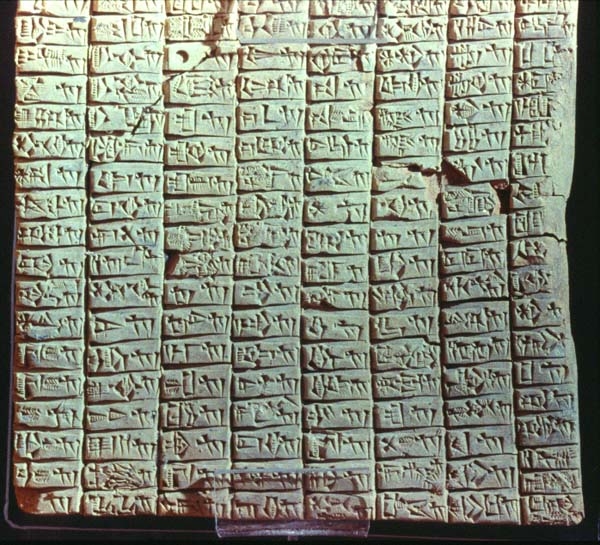
Sodom was the primary city of a group of five Dead Sea cities: Sodom, Gomorrah, Admah, Zeboiim, and Bela (also called Zoar). Located to the south and east of the Dead Sea, these cities appear to have been a confederacy of separate city-states. Beyond the Bible, ancient trading records found in northern Syria, of an ancient city-state called Ebla (Tel Mardikh circa 2700-2200 B.C.), also testify to the existence of these Dead Sea cities. Not only are they listed, but they appear in the exact same order (suggesting significance) as they appear in the Biblical account. The last, or smallest city, appears only using the name Bela, showing it to be the oldest name of the city, with Zoar being supplied in the biblical account to identify its location to readers at the time of Moses.
Ebla tablet circa 2600-2300 B.C. (Click for closer view)
In this early reference to the borders of Canaan, well prior to the time of Israel, an additional clue as to the location of Sodom is given. A single point, Sidon, is the provided as the northern most boundary, located in today's Lebanon, likely where Canaan's territory actual geographically came to a point. Its broadest area was to the south and it's for this reason that the remaining boundary locations provide an west to east line cutting across the bottom of the Dead Sea starting at the Mediterranean. To the southwest were Gaza and then Gerar, while the opposite corner of the southeast was anchored by Sodom, Gomorrah, Admah and Zeboiim. The final city listed, Lasha, is unknown to modern archaeology, but it is assumed by textual location to have also been somewhere near Sodom on the southeast side of the Dead Sea. A very recent theory has again tried to place Sodom north of the Dead Sea, an idea that is improbable for other Biblical reasons we will examine later. It would also make for a strange ordering of border locations in this early Genesis list. The order given logically goes north to south, west to east, but trying to place Sodom north would strangely make it north to south, west to northeast, then south again along the eastern side of the Dead Sea - highly unlikely!
Madaba
map (click for larger view). The location of Zoar (ancient Bela) has been carried to us through time by such things as the Madaba map found in biblical Medeba, Jordan (i.e. Isaiah 15:2). Created circa 527-565 A.D., as a mosaic map on the floor of the then new St. George's church, this Byzantine map correctly portrays the locations and features of hosts of Israeli places. It places Zoar at the southeast of the Dead Sea, matching other early evidences that this is where the cities of the plain were located. Of course, Zoar was the only one having a history following the destruction of the other cities and the plain itself. Modern Location of Zoar: Identified with es-Safi at the Wadi Hesa Hundreds of years after the destruction of Sodom and Gomorrah, when Moses brought the Israelites back to the Promised Land, Zoar was mentioned as a contemporary city. Since Moses, due to his disobedience, was not being allowed to lead the people into the land across the Jordan (west side), God showed Moses the entire land, from Mount Nebo, which He was giving the people.
Notice the way the region is delineated. From Mount Nebo he first looks North (to Gilead, then Dan), then moving his gaze west, he scans the northwest (Naphtali). Continuing counterclockwise, he next sees the western area south of Galilee, yet still north of the Dead Sea and Mt. Nebo (Manasseh, Ephraim). This area stretched all the way west to the Mediterranean (western sea). Next, still continuing his counterclockwise sweep of the area, he sees the land south and west of the Dead Sea (The Negev, Valley of Jericho, and the City of Palms). Even as he began by looking almost due North, Moses now ends by giving a destination almost due south, Zoar which was southeast of the Dead Sea. Again, the geographic reference is compatible with earlier ones and even later historical artifacts such as the Madaba map.
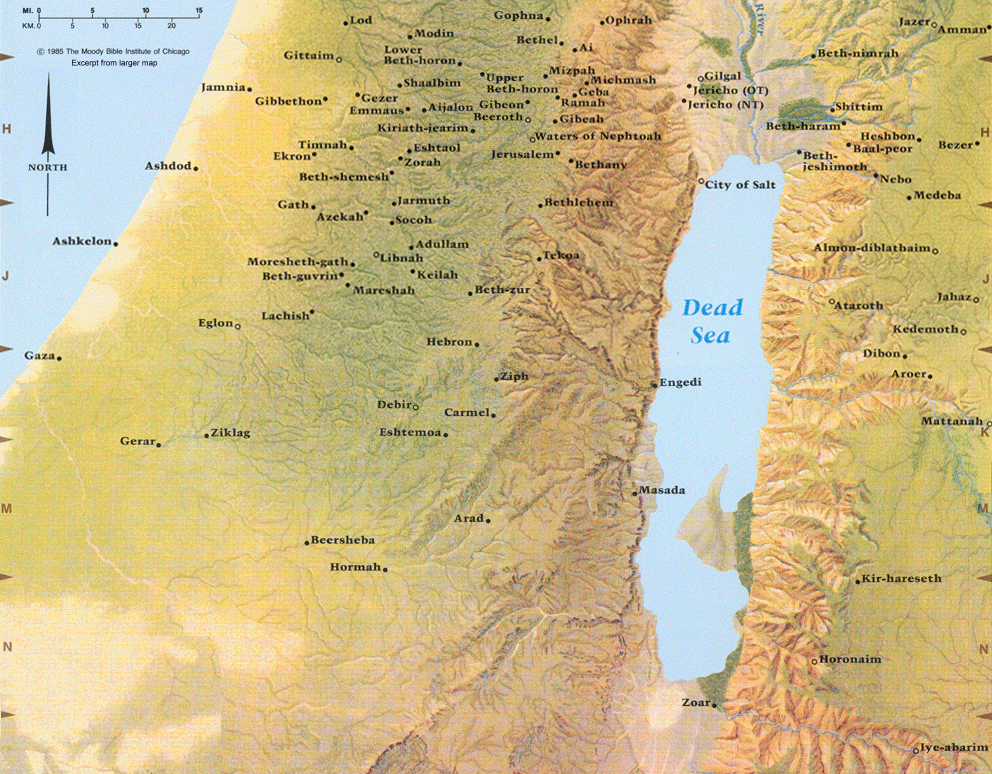
Map of Dead Sea area. (Click for larger view) Some have historically disputed Sodom's location at the south end of the Dead Sea based on Genesis chapter 13. This passage is the account of how Abraham and Lot separated, with Lot ultimately ending up in the vicinity of Sodom...
It is true that Abraham and Lot were on the northern side of the Dead Sea when their separation was formalized. Bethel and Ai were located slightly to the north and west of the Sea, near the top of the mountain ridge. Abraham and Lot would have stood at the top of the mountain ridge and looked out toward the east, having a great view of most of the plain of the Jordan River above the Dead Sea as well as the continuation of that (then) lush area down by the Dead Sea. The Bible text makes clear that this plain was well watered, obviously north of the Dead Sea (the area immediately before them) and to the far south (as far as Zoar). The text goes out of its way to emphasize that this was before the destruction of Sodom and Gomorrah, the event that transformed much of this area into a wasteland, especially the eastern shore as far south as Zoar, encompassing the area of Sodom. Clearly Lot understood the area Abraham was graciously giving him to include the entire plain region, north of the Dead Sea and to the south as well. In fact, the word translated "valley" or "plain" (depending on translation) in verse 12 literally means circle. While it could be used of only the valley north of the Dead Sea, there is no need to such a limitation. Truly the entire region bounded by mountains surrounding the southern Jordan plain and the Dead Sea was this encircled valley - all of it once a fertile plain. Lot perhaps started on the northern side of the Dead Sea, but this semi-nomadic herdsman ended up farther south in the area of Sodom. This may have been out of necessity. Historically the plain area north of the Dead Sea was much more populated, probably leading to issues of grazing rights similar to the very issues that led to him separating from Abraham. Take note that even Abraham didn't stay that far north afterward either, choosing to move about halfway down the Dead Sea (high on the western side) to the vicinity of Hebron. This now strategically (and providentially) positions Abraham closer to Sodom for events which are soon to follow.
Before moving on to examine the events and significance of Sodom, we need to dismiss another supposed location for the destroyed cities and identify their probable locations. Because Genesis 13:13 refers to "cities of the plain (or valley, or circle)" some hold the cities would have to be located directly on the plain. Combining this belief with the Biblical indications that the cities were to the south and east of the Dead Sea and what appeared to be a lack of evidence for any cities on the plain there, it was proposed that locations of the cities were lost to the rising waters of the Dead Sea. It is true the level of the Dead Sea has fluctuated greatly throughout history, making such speculation probable but relatively unprovable. Until now that is. The Dead Sea level has been dropping steadily for decades and is now at the lowest level in history. In fact much, if not all, of the south end of the Sea is in danger of completely drying up. These conditions show there is no evidence for the cities being located directly on the plain.
Logically, it also follows suit that the cities would not have been located directly on the plain for reasons of defense as well. For reasons of fortification, cities of that ancient area were commonly built on more readily defensible elevated areas. This knowledge led to a search toward the outside of the plain, where the ground rises steeply toward the mountainous plateau surrounding the valley. Not coincidently, near the mouths of the major ravines entering the valley area, the ruins of ancient cities were found. This would make the cities out to be the guardian cities of the plain, locations that most entering the plain area would have to pass by. As cities of the plain they economically and militarily controlled the plain region. The Biblical account shows the kings of these cities were incapable of independently maintaining control of their area, having become subject to an external foreign alliance. Their subsequent rebellion against that alliance led to a telling battle.
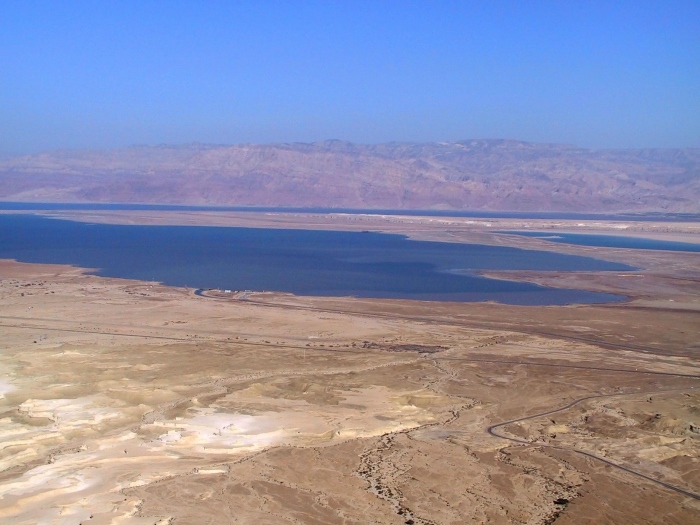
View
across the Dead Sea from western side looking toward eastern side
A number
of important details are provided here, not the least of which is the
implication as to why Lot, a nomadic herdsman, ended up living inside
the city of Sodom. The primary place for battles to be fought was in
large areas of relatively flat terrain. This provided for easy
maneuvering of troops and defined battle lines. If Lot and his
household were living on the plain area, news of an impending battle
would have driven him and any others potentially in the way to seek
shelter. The most logical place to look for such refuge would be the
nearest and largest fortified city, which in this case would have
been Sodom. Next, it needs to be noted where the battle took place,
namely the Valley of Siddim or the Valley of the Salt
Sea. Located to the south of the Dead Sea, close to the historic
location of Zoar, this valley would have been a logically place to
stop a northward advance of troops attempting to make a frontal
assault on the cities through the plain area. Even if the invading
troops had no plans to directly assault the cities, merely occupying
the plain area would have effectively placed them under siege,
through control of their pasture and agriculture lands. |
|
In the defeat of the five kings by the invading four, the five kings and their troops ended up fleeing for their lives. While some sought refuge in the surrounding hills or mountainside, others fell into the tar pits which the valley was full of (see verse 10).
While a few (as above) have said that these tar pits could have been purposely dug for economic reasons, since tar is a valuable commodity, it is more likely they occurred naturally. Some perhaps were used commercially; Egyptians used asphalt to embalm their dead and this was often imported. Sinkholes are common phenomena surrounding the Dead Sea, especially when the lake is at low levels as it is currently. Again, the area has been historically known as a source of natural tar. Almost 2000 years ago, Josephus described the Jordan valley south of Galilee as far as the "country of Sodom" and the southernmost part of the Dead Sea. He refers to the area as "Asphaltiris," the name itself coming from the root word by which we get asphalt.
Not only does Josephus tie Sodom geographically with the southern part of the Dead Sea, he refers to the Dead Sea by the name "Lake of Sodom" in his Antiquities of the Jews (1.22). In covering the time period of Genesis 14, Josephus calls the Valley of Siddim the "vale of Slime Pits," confirming its then current name as the "vale of Lake Asphaltites."
Lot, who sought protection in Sodom, ended up having his goods stolen and becoming captive to invading armies. These raiders then headed rapidly north toward Dan. The possession and household of a wealthy nomad would have been readymade for travel, likely making Lot an easy target. There's even a possibility the ruler of Sodom offered up this foreigner to meet the heavy penalties these invading kings exacted as punishment for rebellion. Fortunately, one witness to all this escaped and sought out Abraham who was still living near Hebron (Genesis 13:18).
An interesting note on this narrative comes from the word translated "trained men" in verse 14. This Hebrew word only appears this once in Scriptures, yet it is a technical term for this type of trained men attached to a particular household. Extra-biblical sources from before this period confirm proper use of this term. Our narrative continues with Abraham's triumphant return...
Understanding that Salem was the ancient name for Jerusalem, the Valley of Shaveh (or the King's Valley) is thought to be near Jerusalem, but this is not definite. Regardless, this passage does not help identify the location of Sodom as the implication is that the king of Sodom traveled to this site in order to meet the returning Abraham. It is quite likely that word of Abraham's victory and soon return had spread rapidly, long before they actually had returned. It is certain thier return journey would have been more leisurely than the forced march north as captives. The Scriptural narrative relevant to Sodom continues some time later, with Abraham again living near the great trees of Mamre near Hebron. It is here that Abraham receives extraordinary visitors with an incredible message.
God was
about to do something so extraordinary that it would be used as an
example by Abraham and his family (nation) after him. In the passage
that follows Abraham repeatedly asks God to spare the cities if
enough righteous people are found there, each time reducing the
number. Knowing how large his own household was, Abraham was most
likely certain that God's final concession, to not destroy the cities
for the sake of ten, guaranteed their survival. There only needed to
be ten in Lot's household serving the Lord! It seems that Abraham was
aware that Lot was once again living in the city of Sodom. In fact,
as we will see in the next passage, Lot appears to have accepted a
form of the honor and accolades Abraham refused from the king of
Sodom (Genesis 14:21-24). Lot, a foreigner, has now been elevated to
the status of representative of the king who would sit in judgment at
the city gate (Genesis 19:1, 9). |
|
View
of the always narrow part of the Dead Sea (south of halfway)
Looking east and slightly north across the Dead Sea from Masada
Notice
the desolate plain on the western side of the Dead
Sea
Southeastern
view across the Dead Sea from Masada |
|
Before considering what comes next, note that Abraham walked with his visitors down toward Sodom. With Abraham's current positioning, half way down the western side of the Dead Sea, yet high on the mountain plateau surrounding, this would have been a walk relatively due east. The departing angels would have then descended into the valley to head toward the eastern side and only slight farther south. Scientists believe the Dead Sea was at one of its low levels during that time of history, so it's possible that the angels did not have to go around the southern shore of the Dead Sea. They may have been able to cross at the area where a spit of land juts westward almost severing the Dead Sea during low levels (as it is currently). Once having crossed there it would not be far to Sodom.
Sodom was a city of wickedness, with homosexuality only one visible symptom of it. God, who knew there were not even ten righteous people left in the city, had determined to destroy the cities as an example or testimony of His justice. Yet, in the midst of this well deserved judgment, God sent the angels to show mercy to Lot and his family.
Lot was a joke to his own family. He had known the lifestyle and practices of Sodom to be sin, yet was willing to compromise his stand against it for the sake of security and prestige. There is no question that Lot was a righteous man, a believer in God, as Scriptures tells us this explicitly.
God displays His grace and mercy to this compromiser. He has an angel virtually drag Lot, and what little of his family remained, out of the city.
|
|
It appears that Sodom's city gate was in the lower part of the city (remember it was built on the rise of the plateau surrounding the valley). This positioning makes sense as a majority of travel, trade, and agriculture, would come through the valley. Also, a gate on the upper side would have weakened the defensibility of the city. It's a lot harder to attack upward than down.
Standing outside the city of Sodom on the plain, the angels told Lot to flee to the mountain - in other words, get out of the plain area itself. Lot, who still hasn't fully understood how gracious God has been in this, worries that he won't have time to make it. To him, the easy path of flight is to stay on the level ground of the plain. Looking southward he spots the last and smallest of the cities of the plain and asks to be able to flee there. This request is granted, which ultimately spares this little city as well.
It takes half a day for Lot and his two daughters to reach Zoar (formerly Bela). On the journey, his wife becomes a pillar of salt in her unbelief. Her disobedient action shows her heart to be back in Sodom. The brimstone God used to destroy the area was likely a product of natural substances found in the region. The sulfurous and salty ground combined with the tar issuing from the ground (remember the "tar pits") make a volatile substance only requiring God to miraculously provide the ignition - fire from heaven.
|
|
View
looking east across the Dead Sea (toward
side where Sodom was located)
Same eastward view encompassing further south and more of western shore The sight awaiting Abraham testifies to a fire fueled by asphalt. Smoke rising from the southern part of the Dead Sea region is easily visible from the plateau area east of Hebron.
Notice that Abraham could quickly return from his location in Hebron, to a place overlooking the valley. Here he could look directly down toward Sodom and Gomorrah's location. This is textual evidence the cities were not above the Dead Sea's north end. As for the scene, it must have been an incredible sight with dense asphalt smoke rising from the whole plain. It certainly is one he would remember and speak about the rest of his life. This was no figurative destruction, but a literal historical event, cited directly by Jesus...
God intended the destruction of Sodom and Gomorrah to be a lasting memorial to His justice and a warning against all who would live in rebellion against Him. In fact, the destroyed cities of the plain were used as specific examples of the desolation that would characterize Israel if they did not keep their covenant with God.
In following years, God's prophets frequently referenced Sodom, noting that if God did not have a remnant they would have become like Sodom and Gomorrah. Even rulers of the people were likened to rulers of Sodom, willfully ruling over and not trying to restrain wickedness.
These passages clearly imply the destruction of the cities was complete and lasting. Dating of this event was around the 21st to 20th century B.C. and perhaps more specifically 2070-2060. Dating of Abraham's time is widely disputed by scholars, so this date is based a literal acceptance of the Biblical record and its genealogies. Abraham would have been born circa 2164 B.C.) If the destruction was only partial or temporary it would not stand as a permanent warning, as God clearly intended. For example, the next three passages specifically highlight the permanency of this Divine judgment.
The needed permanency of this destruction is another primary reason why the proposed site north of the Dead Sea (Tell el-Hammam) cannot be ancient Sodom. Its excavator even states that subsequent stratum show, that while it was destroyed (by fire), only a few centuries later a city was rebuilt at the same location. The estimated time frame for this later inhabitance is 1200-600 B.C. (iron-age) meaning that for a majority of Israel's pre-exile history they would have known this to be an occupied city - hardly an example of permanent and absolute judgment.
A graphic showing the recent speculation of a northern Sodom, as published by Biblical Archaeology Review. Not only was this proposed site never permanently abandoned, its proximity to Jericho also makes it highly unlikely that it would been referred to apart from that important nearby city or that its destruction would not have affected Jericho too. The narrative of Genesis, and the destruction of Sodom and Gomorrah, doesn't end with Abraham's view of the destruction. It returns to the safely rescued Lot and his two daughters. Perhaps the people of Zoar found it strange that only this man and his daughter survived to escape from Sodom, or maybe they superstitiously feared and persecuted Lot as if he was somehow responsible. Regardless, Lot ended up leaving the city he had impetuously asked for and headed to the place he had first been instructed to go.
The descendants of Lot are stated to have been the fathers of two nations, Moab and the Ammonites. This not only claims ties to particular peoples, but implies geographic ties as well. These two nations controlled specific regions on the eastern side of the Dead Sea. Notably, the territory of the older son, Moab, directly bounds the southeast side of the Dead Sea, from the Zered to the Arnon River. This includes the immediate vicinity of Zoar northward to Sodom and Gomorrah and the other destroyed cities. The Arnon River (gorge) was the historic boundary between the Ammonites and the Moabites, which is almost exactly halfway down the east side of the Dead Sea. Once again, this information clearly implies that Lot's post destruction ties to the region were well south of the north end of the Dead Sea. Returning to Josephus, the first century historian, he stated that the ruins of the five cities were still visible to his day (as does Tacitus, History 5.7). Josephus clearly ties the location of the five cities to the southern and eastern side of the Dead Sea, making specific note of Zoar. This excerpt of Josephus is primarily for the last few sentences, but we included those before it as they provide Josephus' description of the Dead Sea; then called Lake Asphaltitis.
Author,
Brent (left) and son, Scott (right) demonstrating
|
|
The best candidates for the ruins of the five cities are as follows:
While many scholars have placed the destruction of these cities at a time consistent with the Biblical time frame, as usual dating is disputed by up to 200 or 300 hundred years by others (claiming the cities were destroyed earlier than the Biblical time frame of Sodom). This earlier chronology is based on imprecise means including carbon dating, so the results cannot be construed as being concrete. A burn (ash) layer was found in regards to their destruction, showing final destruction from the top down, especially including the associated massive graveyard at Bab edh-Dhra. This is consistent with a widespread destruction by fire from above. While some scholars have speculated that an unknown conqueror destroyed and burned these cities, it is highly improbable that such a conqueror would take the time to go to a cemetery several hundred meters (feet) away from the city and individually burn each burial house too. These burial houses have been shown to have also been burned from the outside inward, with the roof collapsing first. The severity of the burning of the cities is shown from the excavation at Numeira, where a dug pit cut through seven feet of dark ash. Additionally, all the cities (except Zoar) were destroyed at the same time, also consistent with a regional destruction. All of the cities date to the same era and were built on a piece of ground overlooking a Wadi (ravine) entering the southern Dead Sea plain. Each was enclosed by a stone wall with a fortified tower and nearby water source. Certainly their destruction and location meets the Biblical criteria for being the cities of the plain. |
|
Tel at Bab edh-Dhra
Another view from top of tel at Bab edh-Dhra (and Wadi Kerak)
Closer
view of Wadi Kerak at Bab edh-Dhra
Ruins at Bab edh-Dhra
Right of highway is Bab edh-Dhra. Left towards Dead Sea is the large graveyard. |
|
Shafts of graves in foreground. Tell of Sodom in background right.
Looking down a grave shaft. Notice horizontal shaft from the main vertical
Another burial shaft with closer view of actual burial chamber entrance below
|